September 22, 2026
Congratulating the winners of the inaugural AI for Industry Challenge at ROSCon Global 2026
If you have spent any time on a factory floor, you know robotics and physics have a habit of humbling anyone who touts a quick fix or fancy demo. Seemingly simple tasks can be extremely difficult to automate – understanding how to manipulate different materials at extreme precision, while anticipating exactly how they’ll move or bend, has made it inaccessible for most. There’s a reason why the vast majority of businesses around the world have not been able to afford, use, or manage robotics day to day – but with the advent of AI and software-driven robotics, things are changing quickly. This is where developers will make the biggest difference.
That is exactly why Intrinsic hosted the AI for Industry Challenge with Open Robotics and our partners: Foxconn, Google DeepMind, NVIDIA, and Universal Robots. We designed this challenge for the broader developer community, which was open to anyone from researchers to system integrators, automation pros, and AI engineers – to tackle an intractable, practically unsolved problem: flexible cable manipulation and connector insertion for electronics assembly.
The result was an extraordinary global turnout: 5,000 developers from 115 countries – shattering our expectations. The challenge ran across 6 months, with the top teams hailing from Europe, India, the US, and UAE. While 73% of registrants were experienced in ROS, nearly half came from outside traditional robotics, transferring their software and AI expertise into the challenge and approaching old problems with new perspectives.
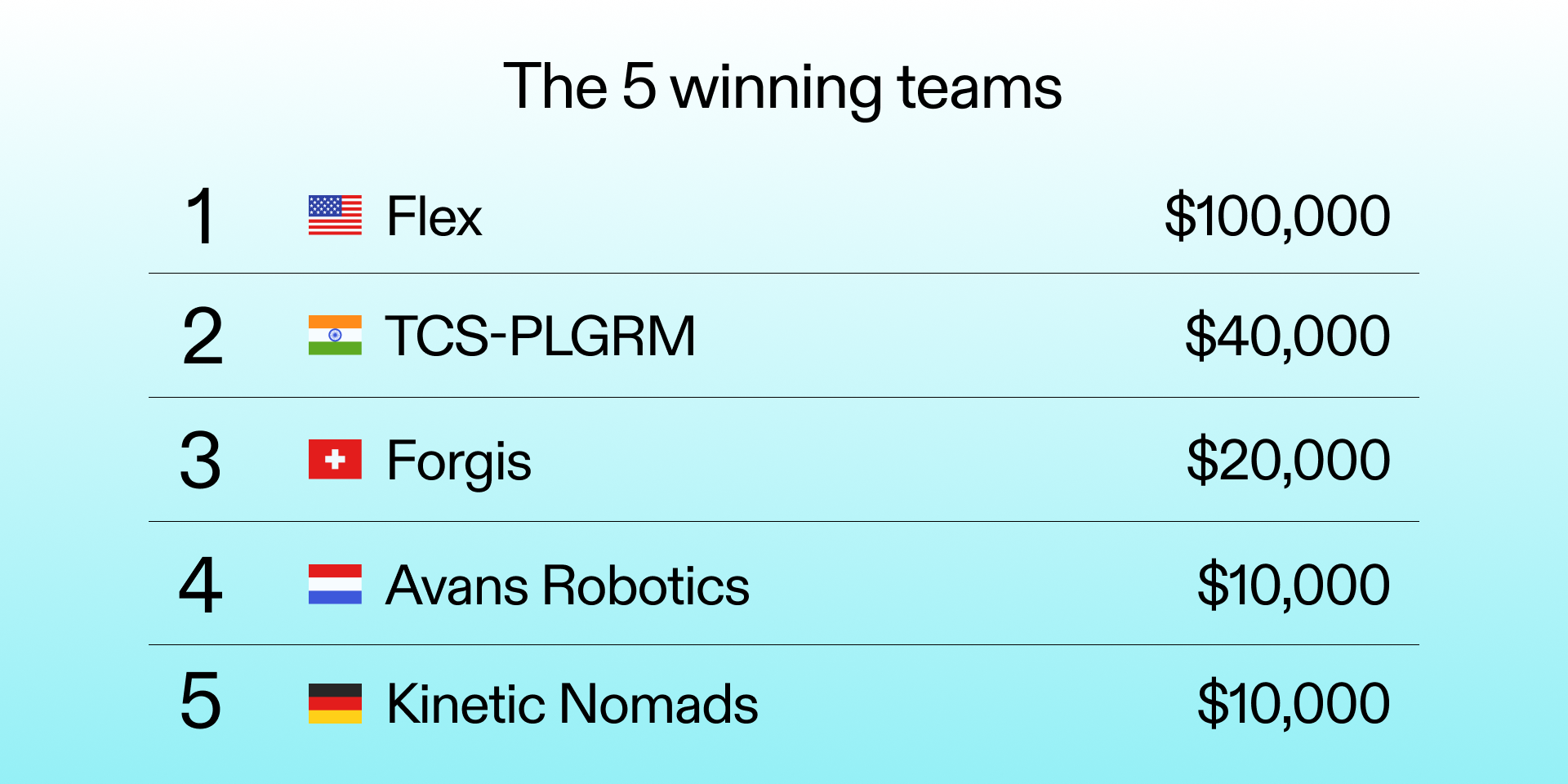
We want to extend a massive congratulations to the winning teams who made substantial progress together, for months in a row. Just two teams achieved 100% success in the final stage of the challenge. Team Flex from the USA won the overall challenge, and TCS-PLGRM from India came in second place. From their remote team locations – thousands of miles from Intrinsic HQ in California where the physical robot workcells were – and through the Intrinsic platform, they deployed high performance solutions that solved our challenge.
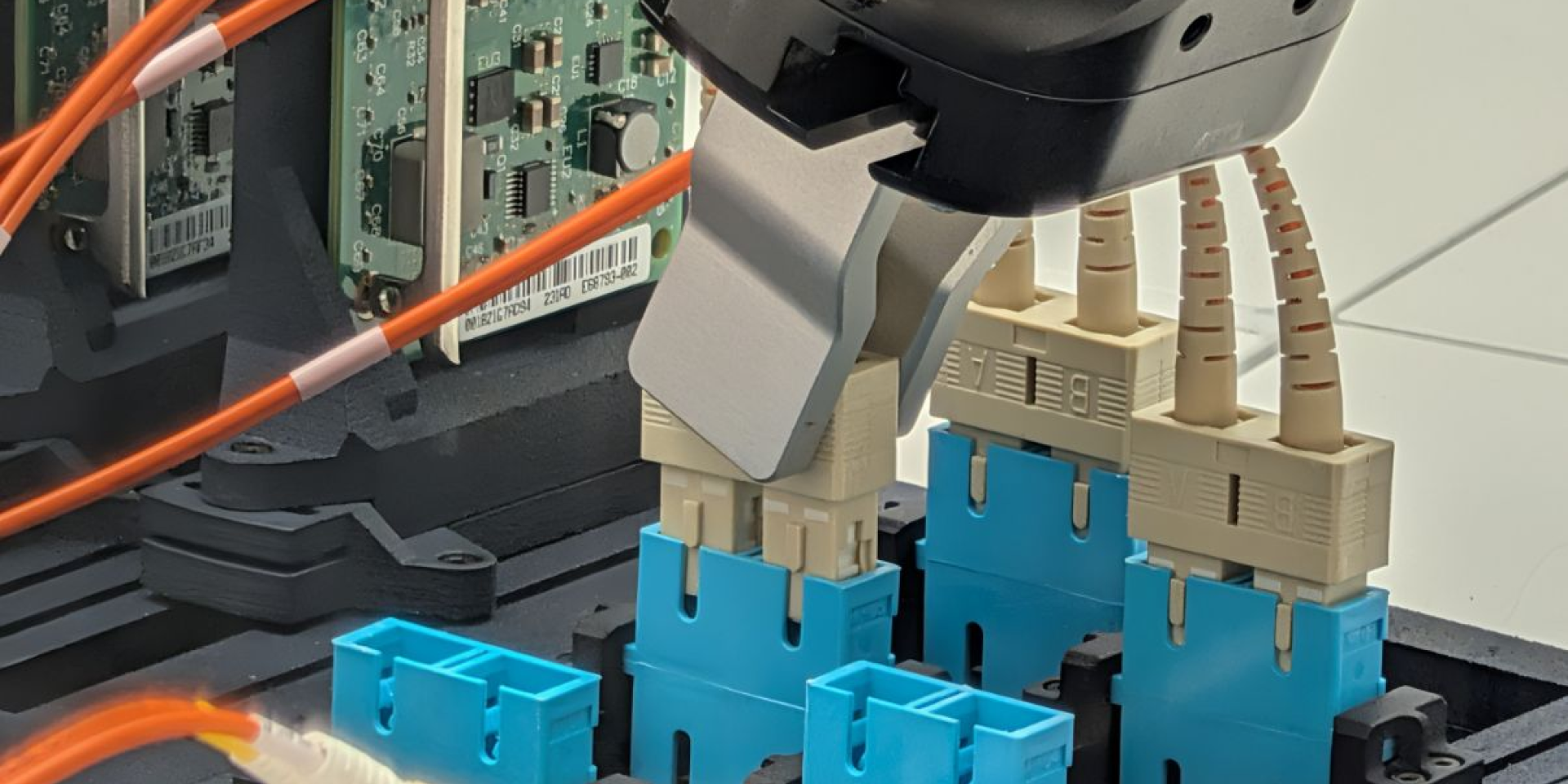
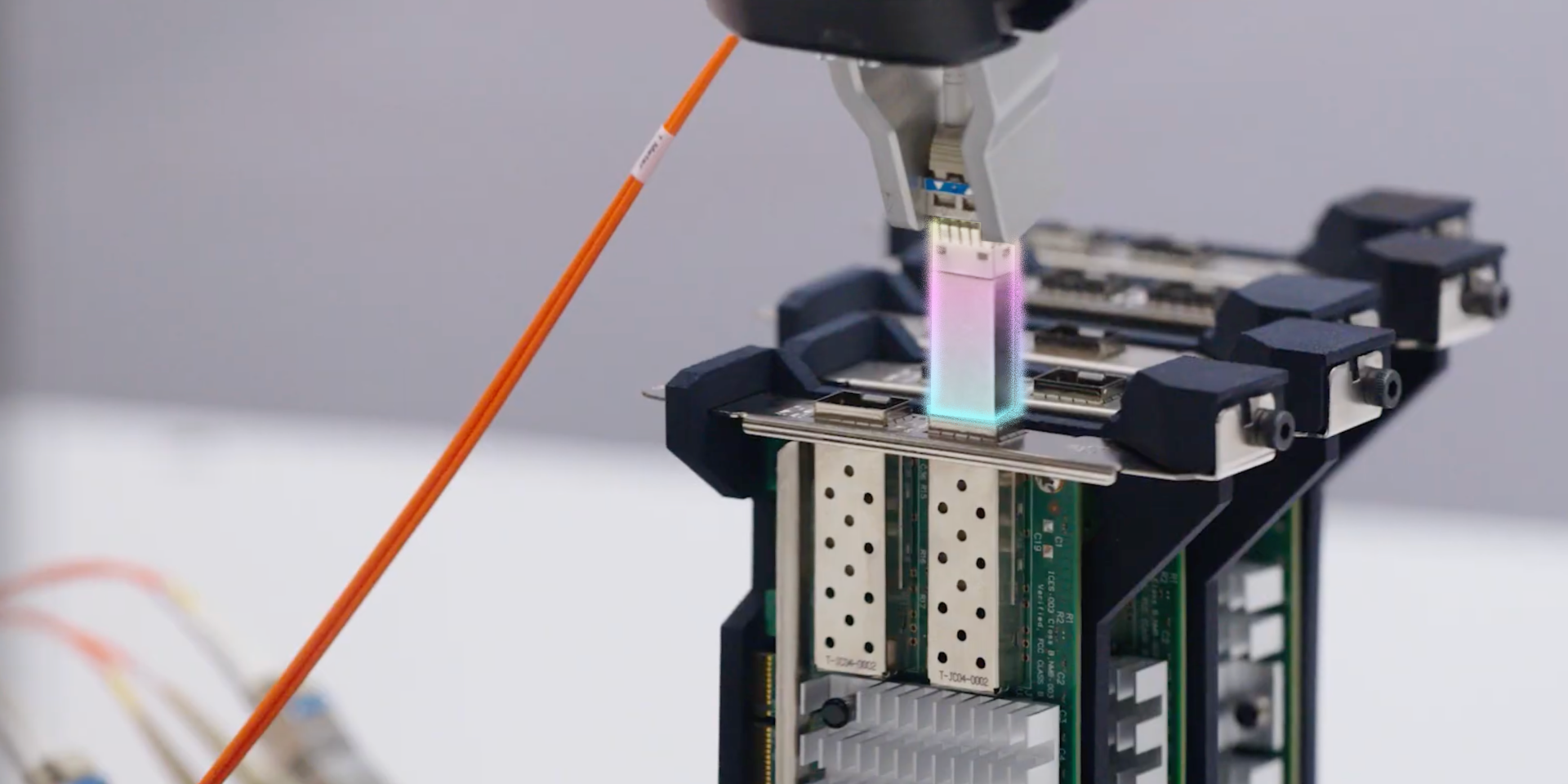
The final-stage real workcell test involved successfully identifying common cable connectors (such as standard connector (SC) and small form-factor pluggable (SFP)) and their location, picking them up, moving them to the right ports on a taskboard (akin to a server tray or motherboard) and delicately but securely inserting them into their ports with a Universal Robot UR5e. This problem is nowhere near solved in industry and even humans have a hard time with this task – even with incredible vision, tactile, hearing, and proprioceptive senses that work together. The connectors are small and intricate, the cables bend, the workspace is complex and the perfect amount of pressure to click into the cable ports is needed. Watching these international teams tackle the problem gave the expert industry judges a front-row seat to the ingenuity and innovative approaches taken to solve the tasks.
The challenge showed us that success does not come from a one-size-fits-all tool, model, or approach. The top teams won by seamlessly stitching together foundation models, classical heuristics, partner ecosystems, and open-source tools like ROS, Isaac Sim, YOLO, PyTorch, MuJoCo, and Gazebo. They built modular, flexible toolchains where they could explicitly choose when to lean on AI and when to trust classical deterministic logic. AI wasn’t a silver bullet, but it greatly impacted how well the solutions worked in real settings and how well related capabilities worked, like motion and insertion. Being able to mix capabilities and skills for categories of tasks, from motion to perception and insertion for example, was the most common theme for 9 of the 10 winners. Intrinsic supported that with containerization, a real-time control framework, and simulation – enabling the right combinations of skills and capabilities to execute at runtime.

0 / 0
The winning team Flex, a group of researchers from Michigan, used a lateral swinging SC cable insertion strategy that self-aligns the connector with the port before insertion.
0 / 0
The defining characteristic of the top-performing solutions was a hard architectural split between perception and action. When it came to locating the components and determining their initial poses, 100% of the top 10 teams used a specialized foundation model, the Intrinsic Vision Model (IVM) for submillimeter, high precision pose detection. It’s fast to deploy and only needs standard 3D CAD meshes to run well in different environments and lighting conditions. A foundation model approach is useful when there are too many variables to tune manually, including lighting variations, shadows, camera noise, and moving objects. AI at this stage successfully narrowed down the scope for subsequent steps, ensuring the robot and gripper were right where they needed to be for the next grasp and force insertion. We also saw participants cross-validating the output of IVM with their own custom-built perception pipelines, often using open source tools like YOLO. This helped refine their pose estimates and improve confidence in their part detection overall.
Once the robot knew exactly where the target was, the approaches typically shifted. In phase two – where the top 10 participants went from simulation to a real workcell, deploying remotely through the cloud – 90% of the top teams chose to use a more rules-based logic approach to insert the connector and leverage real sensor data. They relied on classical, explicit approaches like spiral searches, pattern matching, and alignment corrections. Real-world hardware provided reliable, high-frequency force and torque sensor feedback, and when used with the Intrinsic real time controls framework and other enterprise services, the teams could reliably execute their insertions precisely, with just the right force.
While some teams used AI-based ‘learned’ approaches as backups to the more classical algorithm-based methods, others used pure AI-based approaches for insertion too – it was clear that for now, the hand off from specialized AI to classical was the most efficient and reliable.
0 / 0
Because participants developed their solutions remotely, they relied mostly on open source simulation tools like Gazebo to train and evaluate their policies. In phase one, motion planning and predefined waypoints translated well from simulation to physical hardware. But object-to-object contact, and the physics attached to it, proved far more difficult when moving to real environments, with developers running into some common problems:
The challenge exposed the distinct realities of the sim-to-real gap, and also where AI can help offset it after deployment thanks to the added flexibility machine vision provides.
One eye-opening takeaway from the final physical cell stage had nothing to do with AI, physics simulation, or algorithms. It was cable clutter and if you had a sound strategy to handle it. In actual production environments – like routing cables through complex assemblies – cables land awkwardly and block insertion paths during the physical evaluations.
One team built technically exceptional, highly advanced insertion strategies. However, the absence of a practical approach to mitigating where errant cables fell after one task often hindered the next task. The top solutions incorporated deliberate cable strategies into their workflows. In one surprisingly efficient solution, the robot was programmed to reach out and gently fling the cable around the task board, preemptively clearing a path before the next insertion task. The judges were impressed by these pragmatic workarounds, which are critical in real world deployments for dependable performance. Irrespective of AI or more classical rule-based approaches, anticipating real-world variables dictated success, just as much as the tooling.
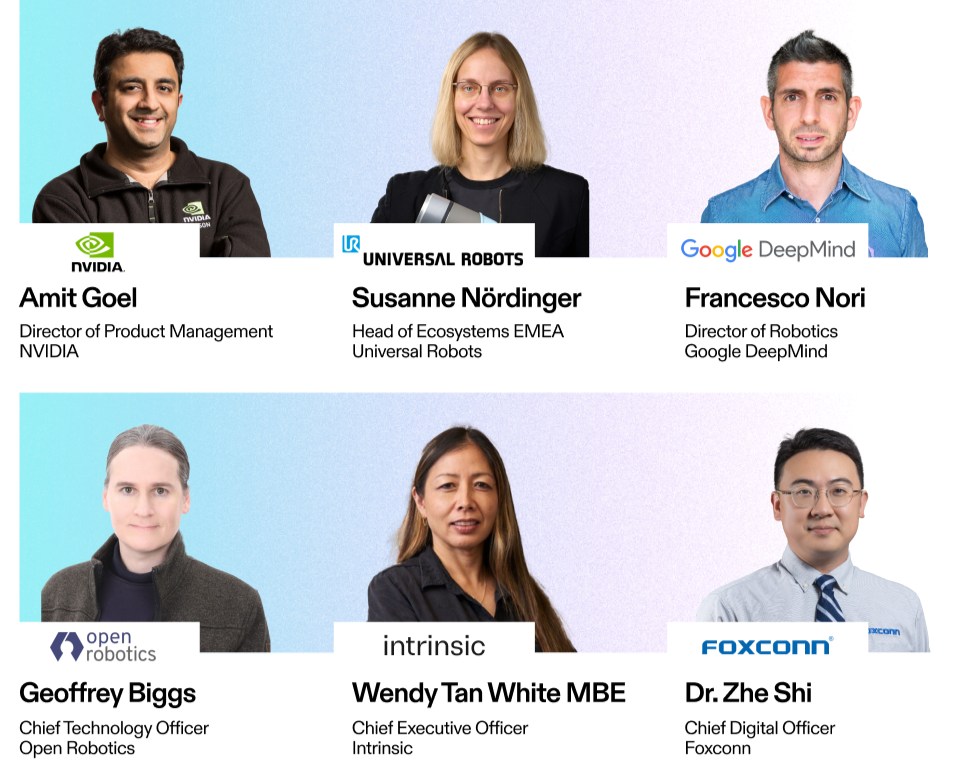
“Tackling a real-world problem of this scale required true innovation, persistence, and technical mastery. Seeing the winning teams' elegant solutions and the impressive journey it took to get there was thrilling. I learned so much judging these exceptional entries!”
- Amit Goel, Director of Product Management, Nvidia
The high caliber of the participating teams was impressive. A sincere thank you to the teams who devoted months of time to tackling this challenge and to our partners Open Robotics, Google Deepmind, NVIDIA, Foxconn, and Universal Robots for championing the challenge. Finding engineering talent capable of building complex, end-to-end solutions like this is extraordinarily difficult. This challenge validated that there is no single correct methodology for tackling industrial robotics and leveraging AI – but combining what works best across platforms is essential to making everything work together seamlessly.
To help accelerate this type of approach, this week we announced Intrinsic Core™ – which offers many of the same ROS-compatible capabilities that teams used in the challenge. It’s available now on GitHub under an open, Apache 2.0 license. You can start building with Intrinsic Core today and help shape the future of this open source effort for intelligent robotics.
Industrial automation should not be built on closed systems. It will become real through talented people using the right combination of creativity, AI, and interoperable tools to solve real world problems in faster, more flexible ways.
0 / 0